How we build your free Search Demand Report (and what it can't tell you)
Most “free” marketing reports are a sales pitch dressed up as data.
You know the type. A thin page of numbers, then a big arrow pointing straight at a phone call.
So when a free Search Demand Report lands in front of you, suspicion is the right instinct. You’ve been burned before, and that caution has served you well.
This one earns its place differently. Here’s the full method, limits and all, laid out before you ask for a thing.
See how it’s made, then judge whether the data holds up.
Let’s start.
The short version
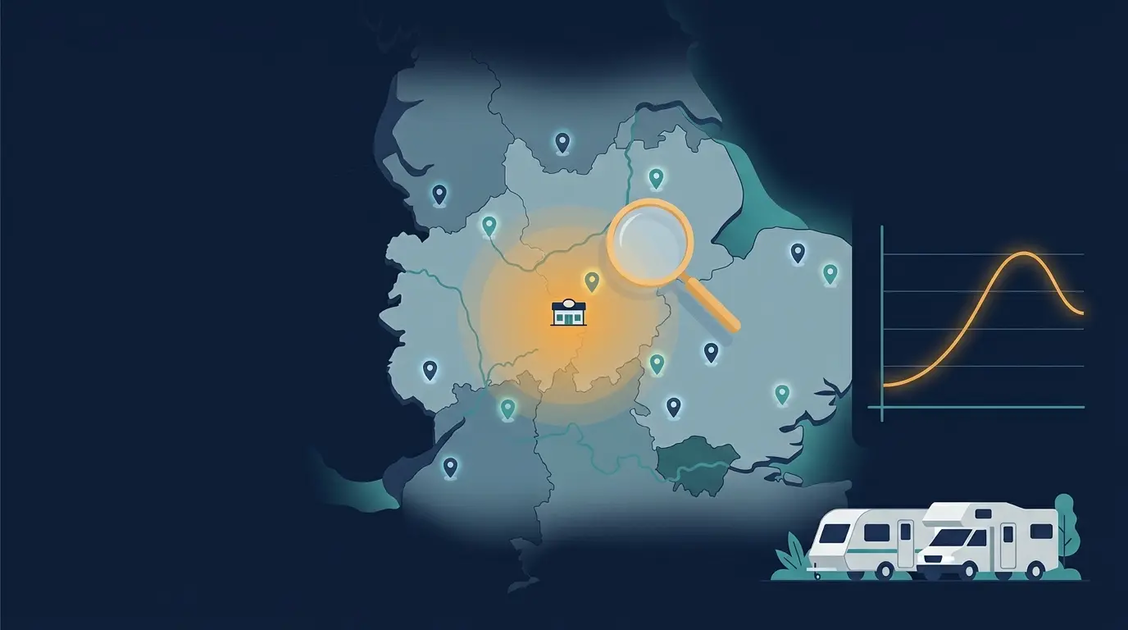
A free Search Demand Report is a short snapshot of real buyer demand around one dealership. It shows what people near you search for, when they search, and whether you turn up.
It’s built from Google search data through DataForSEO, plus live checks of where you and your competitors rank. It runs to three or four pages, and it costs nothing.
How we build it, in three steps:
- Map your area. We take roughly 50 miles around you, county by county.
- Pull the demand. We total the monthly searches for the vehicles you sell, and find the busy and quiet months.
- Check who shows up. We run live Google searches to see where you rank, and where rivals get there first.
Will reads every report before it reaches you.
What the report actually tells you
Forget the method for a moment. Here’s what lands on your desk.
Three things, each one about your patch, not the national picture.
What buyers near you search for, and when. You see the exact terms people use for the vans you sell, across roughly a 50-mile area. “Used motorhomes for sale”, the brands they type by name, the layouts they chase. You also see the season: the months demand climbs, and the months it falls away.
Where you show up, and where you don’t. For the searches that matter most, you see your real position on Google. Page one, page two, or nowhere in the top twenty. No guessing, no vanity numbers. Just where a buyer on their phone would actually find you.
Where competitors win the searches you want. You see which rival dealers turn up for your best searches, and roughly how much search traffic they pull next to you. Named, factual, and never a cheap shot. You may well know them.
Put those three together and you get something most dealers never see: the demand on your doorstep, and how much of it you’re catching.
The how comes next. First, the offer.
Want this for your own patch? Request your free Search Demand Report.
Where the numbers come from
The numbers behind your report come from Google itself.
We use search volume data through a platform called DataForSEO. It’s the same kind of data advertisers see when they plan Google Ads: how many people search a term, month by month, in a given area.
That matters for one reason. It’s Google-wide.
Some demand reports in this market are built from a single marketplace’s own traffic. Useful, but it only shows what happens on that one site. It can’t tell you what everyone in your county is typing into Google.
Ours can. That’s why your report breaks down to your area, not just the national total.
Here’s the honest part, and it’s the part most providers skip. These volumes are estimates, grouped into rounded bands. A term might show as 1,900 searches a month when the true figure sits a little above or below.
They’re directional, not precise to the last search. For spotting what buyers want and when, that’s exactly enough. For claiming a figure to the decimal point, it isn’t, and we won’t pretend otherwise.
We pull fresh numbers each time, and note the date we pulled them. Search demand moves with the seasons, so a report built on last year’s figures would quietly mislead you.
How we draw your area
“Your area” needs a definition, so here’s ours.
We take roughly 50 miles around your dealership and build it from whole counties. We start with your own county, then add the neighbours whose main towns sit inside that radius. For most dealers that’s three to six counties.
Why counties, and not a neat circle on a map? Because the search data comes in county-sized blocks. There’s no dial for “47 miles from my forecourt”. Counties are the closest honest match.
It’s an approximation, and we say so. A circle drawn with a compass would clip the edge of a county here and there. The county method counts the whole thing.
So we list every county we used, right there in your report. You see exactly what “your area” means, with nothing buried in the method.
If you sit on a border, or cover more ground than most, we widen the ring and tell you we did.
How we check where you rank
Knowing what people search for is half the picture. The other half is whether they find you.
So we take the 8 to 10 searches with the most buying intent, the “for sale” and “near me” terms, and run them live on Google. On a mobile, because that’s where buyers research: on the sofa, at night, phone in hand.
For each one, we record three things.
Where you rank, from page one to not in the top twenty. Where each competitor ranks on the same search. And whether a local map pack shows up, with the pins Google drops at the top of the results.
Then a quick strength check. We compare how many searches you rank for against your main rivals, so you can see the gap in plain numbers.
One note on the big marketplaces. Auto Trader and the like will often sit above everyone. We set them aside when we name your local rivals, but we flag them once, because they take clicks you could be winning yourself.
What the data can’t tell you
Every report has limits. Most hide them. We’d rather you knew ours up front.
The search volumes are estimates in rounded bands, not exact counts. We’ve said it once, and it’s worth saying twice.
Low-volume searches show as “too low to measure”. That’s not the same as zero. In a quiet rural county, a niche term may get searched and still slip under the radar.
It’s a snapshot, not a full audit. Three or four pages show you the shape of your market and the obvious gaps. The deeper work, page by page and keyword by keyword, is what a proper project is for.
It shows demand and visibility, not sales. The report can tell you a buyer searched and found you. It can’t tell you what they did next, or whether your website turned them into an enquiry.
And it measures Google, not AI. More buyers will ask ChatGPT and the like over time. For now, most still start on Google, so that’s where we look. Worth preparing for the shift. No need to panic about it yet.
County areas approximate a radius. They don’t replace one.
None of that weakens the report. It just tells you what it is: a clear, honest read of your market, with its edges marked.
Why it’s free, and what happens next
It costs nothing. No card, no tie-in, no small print.
You fill in one short form: your name, your business, your website, and up to three competitors if you have them in mind. We do the rest.
We build your snapshot, Will reads every one before it goes out, and if it’s useful, you can book a 20-minute call to talk it through. If it’s not, you keep the report and we leave it there.
So why give this away?
Because showing a dealer how we read their market is the most honest sample of our work we can offer. Most who see it decide they’d rather we did the heavy lifting than do it themselves. The ones who don’t still walk away with something useful.
That’s the whole idea. Show you how it works, and let the data make the case.
Ready to see your own patch? Request your free Search Demand Report.
Frequently asked questions
Is it really free?
Yes. No card, no obligation, and no catch in the small print. You get the report whether or not we ever speak.
What do you need from me?
Your business name, your website, and up to three competitors if you have them in mind. That’s the lot.
How long does it take?
Very soon. We build your report as soon as your request lands, and Will checks it before it reaches you.
Is my data safe?
Yes. We respect your privacy and use your details only to build your report. You can read exactly how we handle them in our privacy policy.
How is this different from a tool like Semrush?
A tool hands you raw numbers and leaves you to read them. This is read for your area, by people who work this market, with three clear things to do next.
Will you keep emailing me?
No. You get your report, and a call only if you ask for one.
You were right to be careful
You’ve been pitched before. Big promises, a glossy deck, and precious little behind it. So doubting a free Search Demand Report was never paranoia. It was experience.
Here’s the reassuring part. You no longer have to take anyone’s word for it.
You’ve seen the data source, the area method, the rank checks, and the honest limits. You can judge the report before you ever request one.
That instinct that kept you cautious? It’s the same one that will tell you this holds up.
Request your free Search Demand Report and let the method prove itself.